

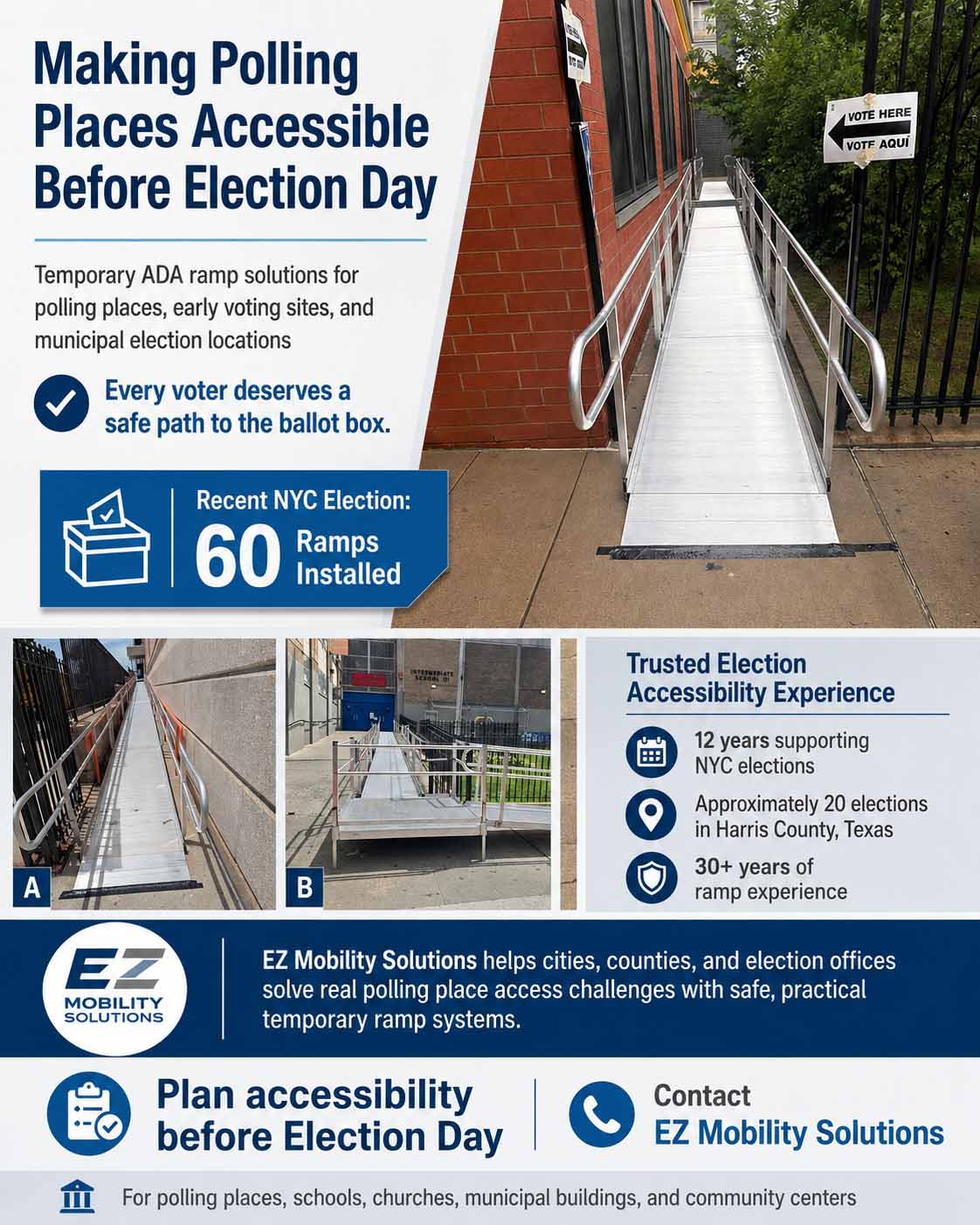

We just returned from another election project in New York City, where our team installed 60 temporary ADA ramps at polling locations so people with disabilities could access their right to vote.
That is the kind of work that matters.
At one polling site, a voter may only see a simple aluminum ramp leading to the entrance. But behind that ramp is planning, measuring, logistics, installation, safety, experience, and a clear understanding that Election Day does not leave room for excuses. When the polls open, the accessible route needs to be ready.
For many voters, a ramp is not just a convenience. It is the difference between being able to vote in person and being forced to turn around.
The Americans with Disabilities Act requires state and local governments and election officials to make sure people with disabilities have a full and equal opportunity to vote in federal, state, and local elections. That includes voter registration, polling place selection, and the voting process itself.
“We Never Have Anyone in a Wheelchair Come Here to Vote”
One of the most common comments we hear when discussing polling place accessibility is:
“We never have anyone in a wheelchair come in to vote.”
That statement deserves a hard second look.
Have they considered that the reason no one in a wheelchair comes in may be because people already know they cannot easily get in?
A person with a disability usually does not need to be told twice that a building is difficult. If the entrance has steps, a steep slope, a narrow walkway, a bad threshold, uneven pavement, or no clear accessible route, they remember. They plan around it. They may vote another way, rely on someone else, or simply decide the process is too frustrating.
That does not mean the polling place is working.
It may mean the barrier has already done its damage.
Accessibility Is Not Just a Legal Requirement. It Is a Public Responsibility.
Cities, counties, and election offices have a responsibility to make sure polling places are accessible to voters with disabilities. That includes voters who use wheelchairs, walkers, scooters, canes, braces, or who simply cannot safely manage stairs or difficult entrances.
But this work should not begin only after a complaint.
It should not take a lawsuit.
It should not take an investigation by the U.S. Department of Justice.
By the time a city or county is forced to respond legally, the real problem has already happened: voters have faced barriers to exercising one of their most basic rights.
The better approach is to evaluate polling locations before Election Day, identify the barriers, and put practical solutions in place.
The Department of Justice’s ADA Checklist for Polling Places specifically helps election officials determine whether a polling place has the basic accessibility features needed by most voters with disabilities or whether temporary solutions can be used to remove barriers on Election Day.
Real Polling Places Have Real Challenges
Polling places are often located in schools, churches, community centers, municipal buildings, fire halls, and older public facilities. Many were not designed with modern accessibility needs in mind.
Some locations have limited sidewalk space. Some have fencing, curbs, steep grades, awkward entrances, tight turns, or old doors. Some have an entrance that looks accessible from a distance but becomes a problem once you look at it from the perspective of a voter using a wheelchair or walker.
That is why experience matters.
A temporary ramp cannot just be dropped in place and hoped for the best. The route has to make sense. The slope matters. The width matters. The entrance matters. The landing matters. The transition onto and off the ramp matters. The entire path from arrival to voting area needs to be considered.
DOJ guidance on common ADA access problems at polling places identifies physical barriers in parking, sidewalks and walkways, building entrances, interior hallways, and the voting area itself. It also notes that the accessible route should connect the path from parking to the voting area and back again.
A polling place may be open, staffed, and ready for voters, but if a person with a disability cannot safely and reasonably get inside, then the job is not finished.
EZ Mobility Solutions Understands Election Accessibility
EZ Mobility Solutions has more than 30 years of experience with ramps and accessibility solutions.
We have worked with New York City for 12 years. We have supported approximately 20 elections in Harris County, Texas, which includes Houston. We have done election accessibility work in our hometown of Roanoke, Virginia, and for cities and counties throughout Virginia and West Virginia.
This is not new work for us.
We understand the pressure of elections. We understand that polling locations have to be ready on time. We understand that the solution has to be safe, practical, and dependable. We also understand that every site is different.
Sometimes the answer is a straightforward ramp installation.
Other times, it takes creative problem-solving to work around tight sidewalks, older buildings, fences, uneven surfaces, and limited space.
That is where our experience makes a difference.
Temporary Ramps Can Solve Real Access Problems
For this recent NYC election project, our team installed 60 temporary ramps at polling locations across the city. These ramps helped create accessible routes into buildings where voters may otherwise have faced difficulty getting inside.
The photos from these sites tell the story clearly.
A ramp along a narrow building entrance.
A ramp system leading into a school.
A ramp placed directly beside a “Vote Here” sign.
That is exactly what accessibility should look like: a clear, safe path to the ballot box.
Not every polling place needs a permanent construction project. In many cases, temporary ramp systems can provide the access needed for Election Day, early voting, or other public events. The key is knowing what will work, installing it correctly, and making sure the route is usable for the people who need it.
Do Not Wait Until There Is a Problem
City managers, election directors, registrars, clerks, and county officials already have a long list of responsibilities. Election accessibility can easily become one more item on a checklist.
But it deserves serious attention.
If a polling place has not been evaluated from an accessibility standpoint, now is the time. If a location has steps, steep grades, narrow entrances, or questionable access, now is the time to address it.
If the only answer is, “No one has complained,” that is not enough.
A lack of complaints does not prove access.
It may only prove that voters with disabilities have stopped trying.
Every Voter Deserves a Safe Path to the Ballot Box
Accessible voting is not about politics. It is about citizenship, dignity, and equal access.
No voter should arrive at a polling place and have to wonder whether they can get inside. No voter should have to be carried, redirected, embarrassed, or forced to ask for help because basic access was not planned ahead of time.
The goal should be simple:
Every eligible voter should be able to arrive, enter, vote, and leave safely and with dignity.
EZ Mobility Solutions helps cities, counties, and election offices make that possible.
If your municipality or election office needs help evaluating polling places or providing temporary ADA ramp solutions for an upcoming election, we are ready to help.
We have the experience.
We have the equipment.
We understand the deadlines.
And we believe every voter deserves access to the ballot box.
Need Help Making Your Polling Places ADA Accessible?
EZ Mobility Solutions provides temporary ADA ramp solutions for polling places, early voting locations, municipal buildings, schools, churches, community centers, and public facilities.
We can help with:
- Polling place access evaluations
- Temporary aluminum ramp systems
- Election Day and early voting ramp installations
- Multi-site election accessibility planning
- ADA access problem-solving for difficult entrances
- Installation, removal, and logistics coordination
Contact EZ Mobility Solutions to discuss your upcoming election accessibility needs.
Helping every voter find a safe path to the ballot box.